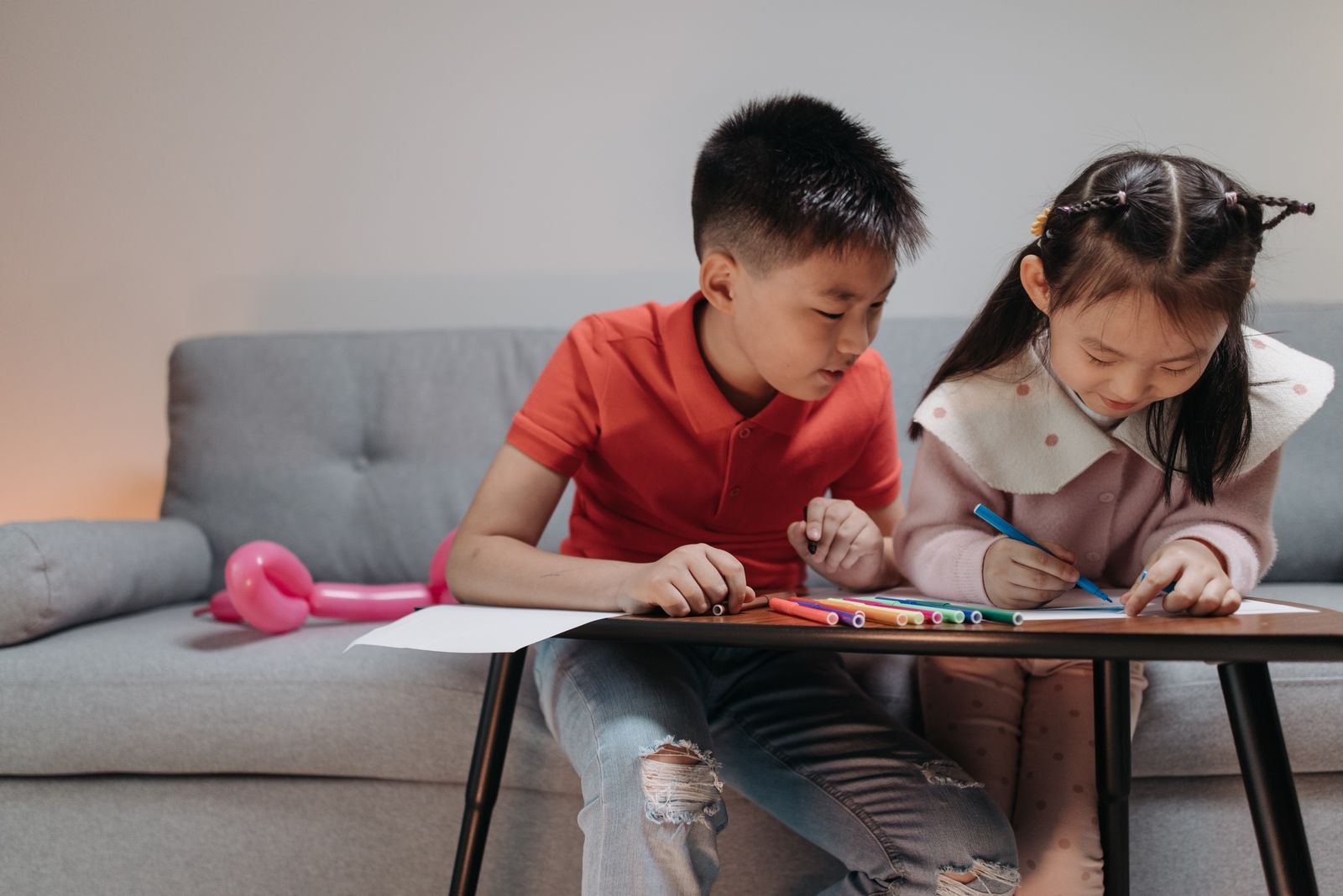
Mixed-age drawing can become awkward when the activity rewards only neatness or recognizable pictures. A younger child may enjoy marks and colors while an older one wants detail. Choose a prompt broad enough that both can make something of their own.
One option is a shared starting shape. Draw a large circle on separate sheets, then ask what it might become. It could be a planet, a face, a wheel or the beginning of a pattern. No one needs to copy another person's solution.
Keep the materials workable for everyone
Offer appropriate paper and drawing tools, with supervision suited to each child. Keep unsuitable small parts or tools separate. A limited selection is easier to share than a large pile in the middle of the table, particularly when children reach across one another's work.
Give each person enough space. Sharing a prompt does not require drawing on the same page. If you do choose a shared sheet, agree on whether people have sections or whether they may add to one another's drawings.
Remove the judging role
Adults can participate without becoming the official evaluator. Describe something you notice or ask about a part of the picture if the child wants to talk. Avoid ranking whose drawing is most realistic or praising one child's work in a way that turns everyone else's into a comparison.
An older child may enjoy giving a younger one a starting line, but should not be required to act as an instructor. Ask whether that collaboration is welcome to both. Sometimes parallel drawing is more enjoyable than a tightly shared activity.
Change the prompt, not the standard
After a round, try a different shape, a favorite place or an imaginary machine. Children can propose the next idea. If someone wants to continue their first picture, let them; the rounds are a way to offer ideas, not a timer that makes unfinished work wrong.
When the session ends, ask what should happen to the pages. Some may be gifts, some may belong in a folder and others may simply have served their purpose. The activity has worked when different ages can spend time at the same table without needing to produce the same kind of drawing.