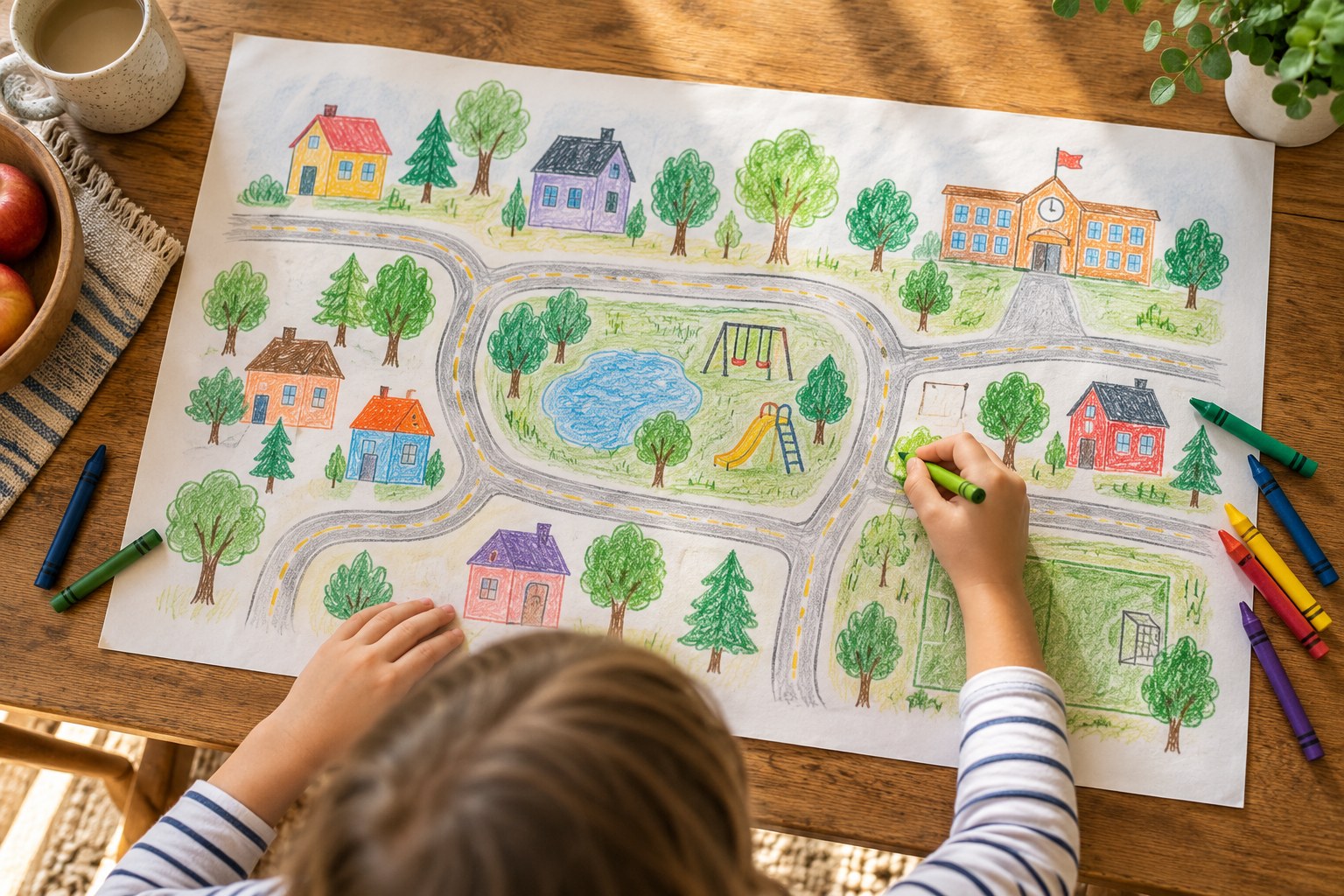
A map-making activity can begin with the route from a child's bedroom to the kitchen. Familiar places give children something to remember and rearrange without requiring a lesson about formal map symbols. Ask which place they want to show someone else.
Use a large sheet and a drawing tool suited to the child. The map can be a picture, a sequence of places or a line with important stops along it. It does not have to be drawn from above, and distances do not need to match reality.
Choose a few landmarks
For a route to the library, a child might remember a large tree, a crossing and a shop window. Ask what they look for along the way rather than supplying the landmarks you consider important. The resulting map can reveal what makes the route recognizable to them.
If they forget a connection, leave space and return to it later. You can walk the familiar route together another time and notice what belongs between the remembered places. Keep ordinary supervision and road safety separate from the drawing game; a child's map is not an independent navigation plan.
Make symbols useful to the maker
A circle might stand for a tree, but it can also be a bench or a meeting place if that is how the child uses it. Add a small explanation beside the drawing if they want someone else to understand. There is no need to replace their symbols with standard ones immediately.
Older children may want to add a key, arrows or alternate routes. Younger children might prefer to tell an adult where to draw something. Both approaches can produce a map worth talking about.
Try giving directions through it
Ask the child to guide a toy figure or your finger from one point to another. Notice where an extra landmark would help, without treating missing information as a mistake to grade. The map can change as it is used.
Avoid including a home address, security details or other private information if the drawing will be displayed publicly or shared online. A simplified imaginary neighborhood may be a better choice for sharing.
At the end, ask whether the map should be saved, displayed privately or used as the setting for another game. Its value is in how the child describes a place they know, not how closely it resembles a navigation app.